I offered to upload the products myself. That was a practical part of Kindred Hands, not just a feature on a website. In Pochampally, the first conversations did not turn into participation as quickly as I expected. After about a week, only one initial contact had sent photographs and descriptions. I then focused on two weavers and kept returning. The gap was between agreeing with the idea and taking the next step together.
Kindred Hands was intended to help weavers and handicraft producers reach customers more directly. I was responsible for bringing the software setup together with mentor support. That did not give me ownership of somebody else's products or authority over their prices. It made the practical question more important: how would their information reach the site in a way they understood and agreed to?
Returning and building trust mattered before a page could be useful. The website had to fit that relationship. An upload button could make entry easier, but it could not make the decision to participate on somebody else's behalf.
I followed one listing through the setup. I started with the product details and followed the steps through the setup. In this case, a weaver has a saree available and wants it shown on the site. Before I even open the product form, I need to understand who is supplying it, who can agree to the details and who will know if it becomes unavailable. Those might be related people, but I should not assume they are the same person.
Then there are the photographs. A buyer needs enough information to understand what they are looking at. A beautiful close-up might show the pattern but leave the size or the whole design unclear. Several photographs could still be confusing if the person looking at them cannot tell whether they show the same product. I don’t need to invent a complicated photography system to see that someone has to make those decisions.
The description creates another small job. Which details came from the person supplying the saree? Which words did someone helping with the listing add? If I’m typing, that does not mean I can decide the material, price or availability myself. Helping enter information and having the authority to change it are different things. I want the setup to make that distinction easier to keep, rather than quietly lose it when everything appears under one account.
A mistake helps me see why this matters. Say a helper copies the details and later notices something that looks inconsistent. Should they correct it immediately, or ask the supplier first? It depends on what the detail is. Fixing an obvious typing error is different from changing a price. The software will let someone click save if their account has permission. It cannot decide whether that person has understood the responsibility correctly.
I’m starting to look at accounts through that question. Who needs to create a listing? Who should review it? Who should be able to change it later? Giving everyone the same access might make the first setup feel simpler, but it could leave the actual work much less clear. At the same time, making every tiny change depend on me would defeat the point of helping people participate.
There’s also the question of time. A listing does not stop needing attention once it looks finished. The product may no longer be available. A buyer may ask something that the description does not answer. Someone needs to know where those questions go. Otherwise I might build the first half of the process very neatly and leave the difficult half as “we'll sort that out later.” That’s a tempting sentence. It does not tell anybody what to do.
This is the useful part of discussing the setup with my mentor. I can bring a much smaller question than whether the whole platform is good. I can explain this one route and point to the place where I have assumed someone will take over. The technical choice comes after we understand that gap. A tool can support a task, but it cannot tell me what people have actually agreed to do.
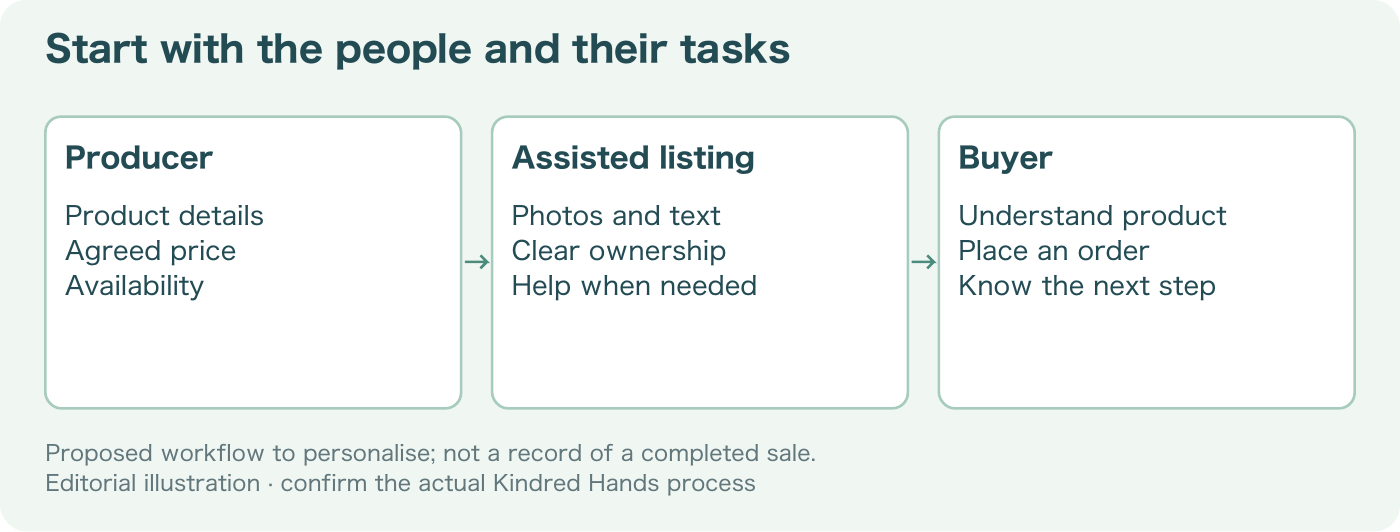
The diagram for this entry is only a way of thinking about that route. It does not show a completed transaction or prove that these exact roles are already in use. What I want it to make visible is the work between having a saree and having a listing that somebody can trust.
I still enjoy thinking about the website itself. There are plenty of parts I want to explore. For the moment, though, this first product is a better place to stay. If I can explain how its information gets onto the site without making the person supplying it do all the unfamiliar work alone, I will have understood something more useful than another feature name.