The first number has quite a journey behind it. In the meter, the voltage module and current clamp produce signals for an ADS1115, and the controller receives digital readings over I²C. I like following that route because it makes the project more interesting than a screen full of values. My report gives the starting aim plainly: build and understand the meter rather than buy a plug-in wattmeter. I started the first build in June 2025 and worked on it for about four months. Looking through the saved programs now gives that broad aim some very particular steps.
The part that interests me is the journey from something happening in a wire to a number on a screen. There isn't a number travelling out of the sensor with a label saying voltage. There’s another electrical signal, which the rest of the circuit has to handle. The ADC changes that signal into a number the controller can read. Then the program has to interpret it. I keep thinking about the display at the end, but there are quite a few places where I could misunderstand something before getting there.
I'm starting with one path rather than every quantity the finished meter might show. The voltage side gives me a way to think about the stages: the quantity being measured, the sensor's output, the ADC reading and the calculation. Each stage has its own units. If I forget that, a perfectly reasonable-looking number could mean something completely different from what I think it means. A raw ADC value is not automatically a voltage in volts, and the voltage at the ADC is not automatically the original voltage I wanted to measure.
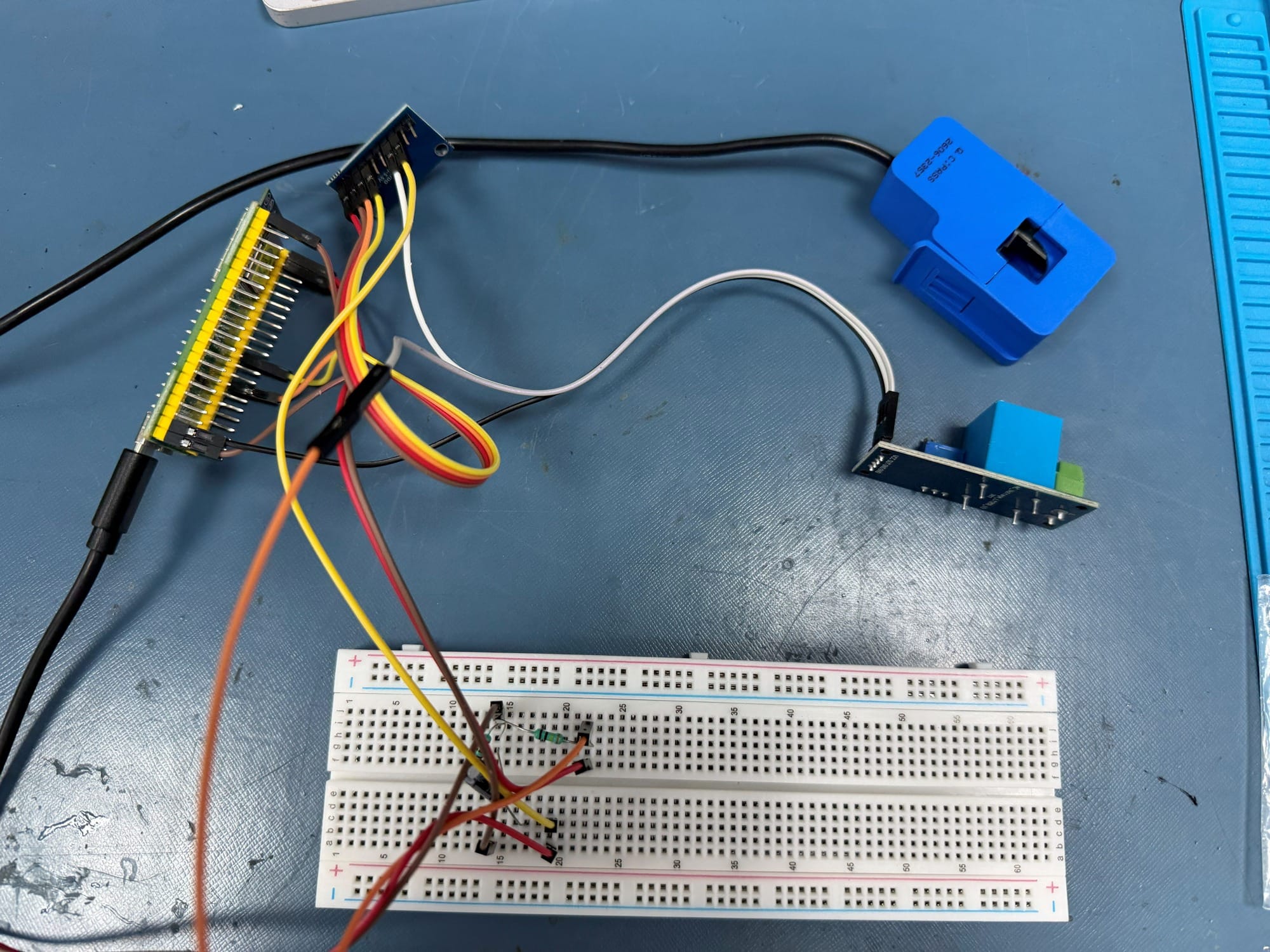
Following the signal through the circuit makes the difference easier to see. In this case, a sensor gives a small changing signal for a much larger changing quantity. The controller reads the small signal. To report the original quantity, I need the relationship between the two. If I skip that relationship and put the ADC number straight on the screen, I still have a display. It might even change when the input changes. That doesn't make the displayed label correct.
There are actually separate programs for those steps. The scanner asks whether a device answers. The raw sampler prints an integer count beside the voltage calculated from it. The RMS program turns a collection into a magnitude. The full meter then combines the channels in further calculations. That makes one number a useful starting point: I can choose which stage I’m explaining instead of treating communication, conversion and power as one success. A 0x48 response belongs to the first stage; ADC-input volts belong to the next. Neither label has to carry the meaning of the whole instrument.
Current adds a second path, and I can already see why I shouldn't treat it as the first path with another name. The current clamp has its own behaviour and scaling. Eventually the two paths meet in the power calculations, but that makes understanding them separately more important, not less. If one is wrong, multiplying the two together won't somehow make the answer better. There’s a slightly uncomfortable freedom in software: I can label a value almost anything I want. The circuit won't stop me from printing watts beside a number that doesn't represent watts.
I like the idea that some of the physics I've studied will stop being a formula I use for an answer and become part of something I have to make sense of myself. I recognise words such as RMS and power factor. I don't yet have a clear explanation of every step between a sensor reading and those quantities. That gap is probably where most of this project is going to be. It isn't just learning the definitions. It’s noticing where the definition asks for information that my program may not actually have.
For example, a changing signal raises questions that a single reading doesn't answer. When did I take the reading? How many other readings do I need? What happens between them? A number could be correct for one instant and still be a poor description of the signal over time. I don't need to solve every one of those questions before beginning, but I want to remember that the final display is a summary of a process. If I only concentrate on making the display look complete, I could hide the interesting questions from myself.
There will be help involved. Reference material can explain a term again when I get stuck, and my mentor can help me work through the circuit and the decisions I don't understand. I want the questions I take to them to come from something specific in the project. Otherwise I can collect a lot of explanations without being able to connect them to the board. I also want to keep track of which parts I wired, adapted or understood with help. It will be easier to learn the next part if I know how I reached this one.
That’s the route I want this account to make visible. The satisfying number is one whose units, scale and place in the program I can follow, all the way back to the information the sensor supplied.