The continuing costs around the first route changed the direction of my Kindred Hands setup. I had looked at WordPress and Dokan, then explored open-source alternatives and linked the chosen pieces with support. The cost question did more than send me looking for a lower price. It changed what I had to take responsibility for.
Kindred Hands was a not-for-profit initiative, so getting a first version onto a screen could only be part of the decision. The arrangement also had to make sense as something we would keep using. A lower licence charge could be useful, but the work of connecting the pieces still belonged somewhere. That made it important to think about what starts with a choice, what continues afterwards and who has to understand it when the first excitement has passed.
The period covered by a price matters as much as its size. A setup amount and a renewal describe different commitments. A quote and a payment describe different stages too. Keeping those distinctions clear makes the comparison easier to understand, because I can follow what each amount is actually supposed to cover.
A cost example makes the problem easier to think through. In this case, one option gives us a particular function through a yearly subscription. Another option provides software without a licence charge but needs more setup work. It would be misleading to compare only the subscription against zero. The second arrangement still has to run somewhere, and somebody has to understand it when it needs attention. I’m not assigning figures to either route in this example. I’m asking what belongs in the comparison.
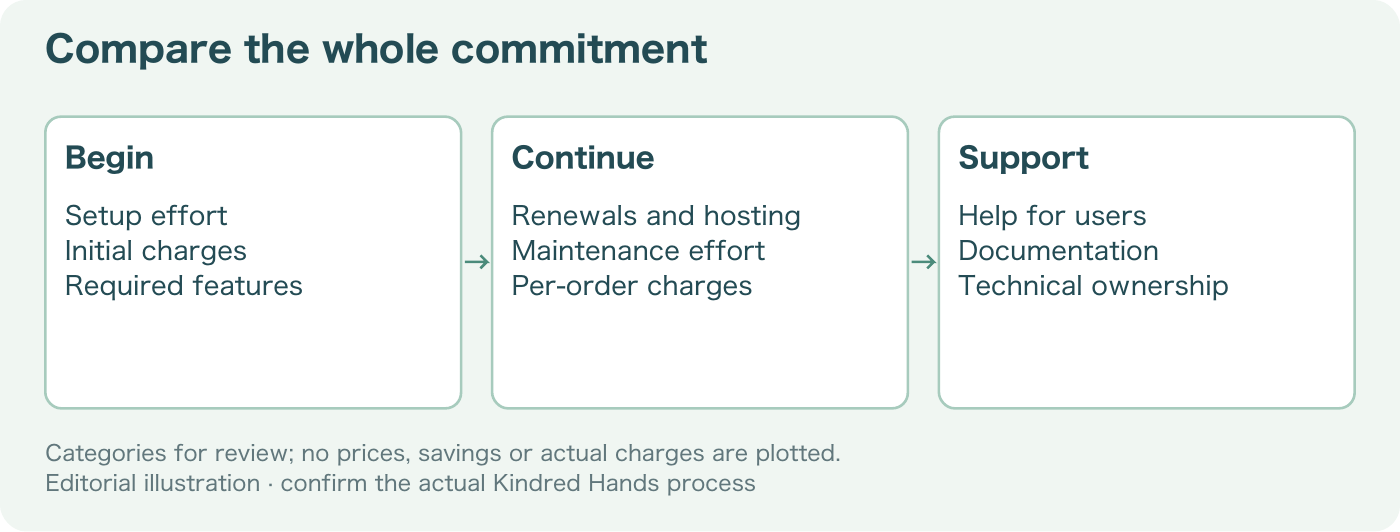
There are also features that can look optional until I follow the actual task. A general description might say a tool handles sellers, but the particular way we need sellers and helpers to work could require a different option or another component. If I discover that late, the cost feels hidden from my point of view. That does not prove a company deliberately concealed it. It may mean I did not understand the full requirement when I first read the page.
That’s a slightly uncomfortable thing to admit. I would like a simple explanation in which I found the expensive thing, found the free thing and solved the problem. The useful version is messier. I’m learning what the problem includes while I compare the tools. Some of the later questions are questions I could not have asked clearly at the beginning.
For a not-for-profit effort, a continuing charge is not automatically wrong. Software can save time, reduce confusion or provide support that would otherwise take effort to arrange. The question is whether that charge makes sense for the work Kindred Hands needs and whether people understand the commitment. I don’t want to choose an option only because it starts quickly and then leave the organisation dependent on a bill nobody planned around.
The time period matters too. A setup cost and a yearly cost cannot be placed beside each other as if they describe the same thing. A forecast for one month will favour different choices from a comparison over a longer period. I want each amount to say what period it covers. Without that, a neat total could hide more than it explains.
There’s a second kind of cost that is harder for me to see on a product page: the work that falls to somebody else. If a tool is inexpensive because the organisation has to do more manual checking, I should understand that trade-off. If it is more expensive but removes a task that was genuinely difficult, that also belongs in the discussion. Neither conclusion follows just from the licence.
These questions gave me a reason to explore open-source alternatives. That’s the change in the journey I care about here. The cost review did more than make me hunt for a lower price. It made me ask which jobs were essential, which choices created continuing obligations and which parts I might be able to connect differently with help.
I want to discuss the assumptions with my mentor while they are still choices. A useful explanation of the first route should include what it offers as well as why another arrangement might fit better. Otherwise I could turn a practical decision into a story about software teams competing to have the longest feature list.
The cost diagram is useful precisely because it leaves room for those different kinds of commitment. It’s not a picture of an invoice, and it does not prove a saving. I read it as a reminder to look beyond the first purchase decision: what starts now, what continues later and what somebody will have to understand. That’s the part a single price cannot show.
I have not reached a magic total that answers everything. What is clearer is the question: if Kindred Hands chooses this arrangement, what is it agreeing to keep doing and paying for? That’s a much better question than the one I started with, which was mostly whether I could get the first version onto a screen.